
The ERD 5V 2A Adapter with Micro USB cable is a popular, budget-friendly power solution frequently showcased on platforms like Pinterest for its versatility in DIY electronics and mobile charging.
Manufactured by ERD Technologies, it is specifically designed for stability and safety across various devices.
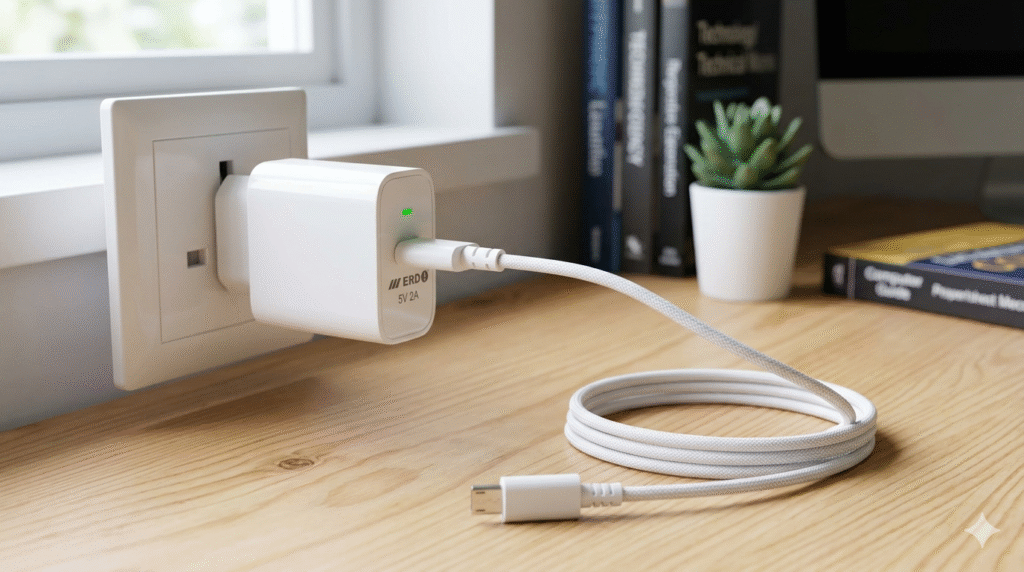
Key Technical Specifications
The adapter is optimized for the Indian power grid and provides a regulated output suitable for sensitive electronics.
- Input Voltage: $150\text{V}$ to $240\text{V}$ AC, $50/60\text{Hz}$.
- Output: $5\text{V}$ DC at $2\text{A}$ (10W maximum).
- Cable: Typically includes a 1-meter Micro USB cable.
- Protections: Built-in short circuit, overload, and overvoltage protection.
- Efficiency: Designed with SMD technology and an inbuilt automatic voltage booster to handle low-voltage conditions.
Common Use Cases
Pinterest posts often highlight this adapter not just as a phone charger, but as a reliable power source for specific hardware:

- Single Board Computers: Frequently recommended for Raspberry Pi 3 and Orange Pi boards, which require a steady 5V 2A supply to avoid “undervoltage” warnings.
- IoT & DIY Projects: Used for powering ESP8266/ESP32 modules and Arduino-based projects.
- Mobile Accessories: Compatible with smartphones, power banks, Bluetooth speakers, and headphones that use a Micro USB port.
Why It’s Popular (The “Pinterest Appeal”)
Users often share this specific model because of its balance between cost and certification:
- BIS Approved: It meets Indian safety standards, making it more reliable than unbranded “white-box” adapters.
- Compact Design: Its small form factor makes it ideal for travel or for fitting into tight DIY enclosures.
- Durability: Features a high-gloss or matte polycarbonate cabinet that is shockproof and heat-resistant.
Note: While this adapter is excellent for Micro USB devices, newer smartphones may require USB-C or higher wattage (e.g., 18W+) for “Fast Charging” capabilities.
Would you like help finding a specific version of this adapter, such as the one optimized for Raspberry Pi or a newer USB-C variant?